
This week I found a number of great articles about the Digital Divide, what it means, and its impact on libraries and education. As I work in an urban library, this material directly relates to me. I found it very interesting and something I can directly apply to my future dissertation. For summary I chose the white paper by Brown (2020) entitled, “Learning in the Digital Age.”
Overall, access to technology for many is limited because of things like monetary funding, physical access to a computer or tablet, use of only a phone (which does not disseminate the same information as a computer!), lacking internet connectivity, ageism, living situation, school access, and integrated technology. Brown sums it up in the following graphic:
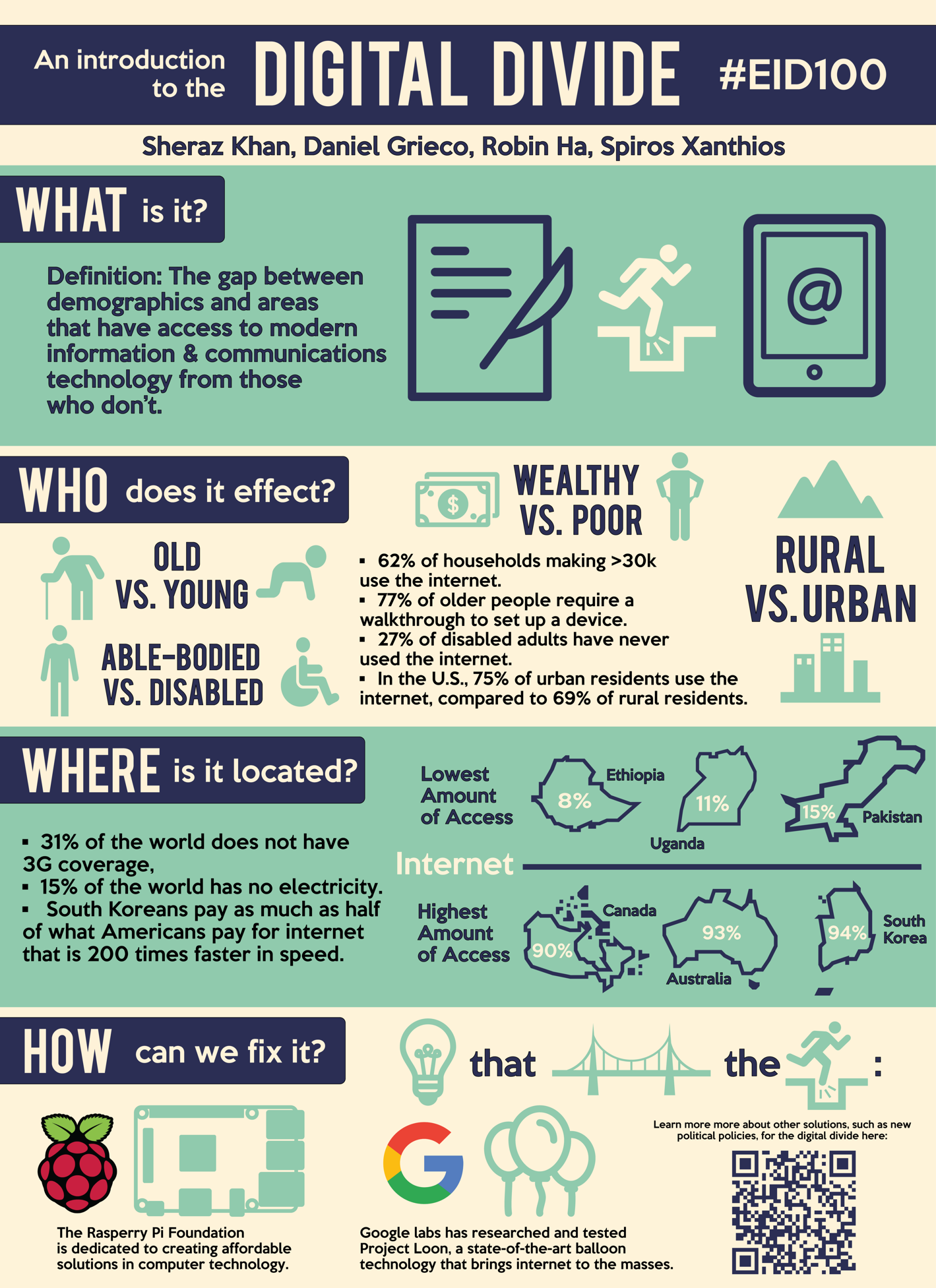
One must engage by reading (through wifi), have motivation, and develop learned skills by practice (online). These things are not possible without connectivity. The perfect place to get connectivity is the library, if only more people were aware of our services and offerings. Fixes like the Rasperry Pi Foundation, Google labs’ Project Loon, and the idea of bridging the gap are real solutions to this current problem.
Works Cited
- 2012 Minnesota Internet Survey: Digital Divide 2.0 and Beyond.(2012). Center for Rural Policy and Development.
- Bertot, J. C., & McClure, C. R. (2007). Assessing Sufficiency and Quality of Bandwidth for Public Libraries.Information Technology and Libraries, 26(1), 14-22.
- Blumenstein, L. (2009). Pew Highlights digital Divide on Mobile Devices.Library Journal, 134(9), 17-21.
- Brown, W. in Asino, T. I., Ed. (2020). The Digital Divide. Learning in the Digital Age. Creative Commons 4.0. https://open.library.okstate.edu/learninginthedigitalage/
- Graham, R., & Choi, K. S. (2016). Explaining African-American Cell Phone Usage Through the Social Shaping of Technology Approach.Journal of African American Studies, 20(1), 19-34.
- Hudson, H. T. (2011). The digital divide. Instructor, 121(2), 46-50.
- Kuelker, T. (2024). CROSSING THE DIVIDE: An Urban Librarian’s Awakening to the Digital Divide in Rural Public Libraries.Computers in Libraries, 44(4), 4-7.
- Osika, B., & Kaufman, C. (2012). ‘Mobilizing’ Community College Libraries.Searcher, 20(9), 36-39, 46.
- Tang, Q., Kamarudin, S., Saiful Nujaimi, A. R., & Zhang, X. (2025). Bridging Gaps in Online Learning: A Systematic Literature Review on the Digital Divide.Journal of Education and Learning, 14(1), 161-176.
- West, J. (2017). Keep Your Promises for a Better User Experience.Computers in Libraries, 37(2), 9-11.
Abrami-et-al access AI annotation Artificial Intelligence content-knowledge creativity critical analysis datacasting Digital Divide ed research ed tech EDU800 education education research Erhel Hrastinski Jamet Kellie's Blog Knobel Leander Leu Li-et-al libraries Michigan Niess&al OMMI online-learning PCK pedagogy research questions Richarson&Swan Saubern&al Singh&Thurman technology TPACK Valverde-Berrocoso-etal Villa&al week8 Week9 week 10 week13 week14 week15 week16